Students: Your resume sucks. Here’s how to fix it

Most student resumes suck.
You don't have much experience, and you know that there's a specific format, but it's a mystery. You don't have experience, so you added a bunch of filler statements lifted from sample resumes. Your objective is just to get any job, but you can't say that, so you string together a bunch of phrases from samples on the internet.
You've just sent me a perfectly formatted word spew that says exactly nothing about you, the individual. Great. Your resume looks like every other bland Word doc that's come across my desk for the last 3 weeks.
But, but but I have no experience! I only have 2 sentences about working at Cheez-e Burgers.
Hiring managers know you don't have experience. They're OK with that. Really. They know you have to start somewhere, but they're looking for someone who is both interested in the work and interesting to be around. After all, they're going to be with you for 8 hours a day, who wants to work with a dullard or prima donna?
I've always loved hiring interesting students. How did I find them? Easy: Their resumes towered like a giraffe in a savanna full of cattle. They had no experience but I knew they would be good. They had little, but they had spark.
So, what do you do when you've only worked retail and had a couple of internships?
Don't be a cow.
Books and student advisories actively suggest these generic formats. You become one of the herd. What difference do you make? We can fix that.
Tell a story
You’ve probably done cool projects in or outside of school. What have you done? What things were you passionate about? Talk about those.
Tell the good stuff
Talk about the things you loved in your projects. Find the things that make you light up. Talk about them. Bury the boring stuff that everyone tells you to keep in because it's expected.
One student I worked with served up a gruel of bland words on marketing, and when we talked, he was dead inside. When I asked him to talk deeper about the computer art exhibit he helped build, he came alive. It turned out he did really amazing things; he was a curator and hosted an industry-famous engineer and pretty much single-handedly ran the show. But those things, they never showed up on his resume.
Show the spark
Don't talk about the office drama or crap you suffered through. That's mundane and off-putting. Think about it, do you want a romantic first date to talk about the warts between their toes? No? You want to hear about possibilities. That applies here, too. Don't do that to your future mentors.
One woman had listed 'marketing assistant' for a nonprofit with little supporting detail. The nonprofit faced a lot of challenges, like every other nonprofit. It turned out that she was making geo-fenced Snapchat ads and ran sophisticated, multi-lingual email marketing campaigns on her own. That's the stuff you want to talk about!
Make it quick
Make 2-3 sentences each that describe the project to a stranger. Short sentences.
Imagine you're on an elevator. With someone looking for a new employee. Someone who wants to help you, but doesn't have much time and doesn't really care about every detail of your life story. You have a few seconds to tell them about what you did last summer. Keep it short and sweet, Tolstoy.
Format your project
Each project should give a quick and easy read. This is not a college essay. This is not a Norse saga. Nor is it a timeline of your dairy-induced gastrointestinal struggles.
- What was the purpose of the project?
- What was your role?
- What was the outcome?
- What did you learn/how did it influence you?
Then, stop writing.
Group the projects
Forget chronological listings for a minute. Is there a logical theme behind this?
Think about this. You were part of a whale rescue effort. You spent days living on the beach keeping that thing wet and breathing while you waited for it to swim back out to sea.
That time profoundly changed your life. Now you volunteer to protect hermit crab breeding grounds. You also help your professor classify barnacles in your spare time.
Should the story be: I want to be a marine biologist. I classify barnacles, I do the hermit crab thing, and a while back I helped save a pod of right whales...? That's the chronological setup. But it feels out of order, doesn't it? Little fun thing, bigger thing, huge thing.
Or, is this a better story: I want to be a marine biologist. 3 years ago, I had a profound experience helping save a pod of right whales. Since then, I've been helping protect hermit crab love hotels, and I also classify barnacles for fun...
Think about this format: huge thing spawned big thing, and little fun thing is fun.
Replace Objective with Summary
Don't try to kid me, you just want a job, any job to get started. Telling me you want a dynamic career in a growing industry wastes my time. Instead, summarize your experience in 2-3 short sentences and tell me how it relates to my needs.
I want someone who is detailed-oriented to process paperwork? Maybe you created the work roster to keep the whales hydrated. Try a summary like this:
Summary:
Detail-oriented Marine Biology major at Arizona State with strong interests in whales and barnacles. Organized work roster to save pod of right whales. Manage site upkeep rotation schedule as part of the HCLH project to protect hermit crab love hotels. Classify barnacles for fun.
Be an alpha-cow. Use a better format.
The generic resumes? They go in the trash. The whole thing about Objective statement, education first, and chronological work? Sure, that works. For everyone. You're not everyone. You’re better.
Try this:
Name, contact details
- Summary
- Student project 1
- Student project 2
- Student project 3
- Education
- Honors and awards, activities
- Non-relevant work experience
See what I did there? I put the stupidly cool stuff up front where it matters. We know you're in school. We know you did stuff in school, and we know you probably donned a polyester polo shirt and name tag in high school to make some pocket change. I don't want to slog past that. Start with the good stuff and we'll probably never get to the fact that you were fired as a Staples cashier.
I also dropped the objectives statement because it says exactly nothing. Instead, I gave you room to explain how your experience matches up with the job listing.
The few, the quick and the obvious
Simple, silly things that matter:
- Check spelling manually. Read your resume backwards, it helps you focus on the word rather than skimming past a huge typo out of boredom.
- Use margins. Better to have some breathing room than to have big text and no whitespace.
- List your phone number. List your address.
- Have a bland email address. Kegfekkr420@yoohoo. com isn't great.
Yes, this doesn’t follow the chronological, bland format. Some of the things I tell you break rules. Your professors will glare. Your mom may weep. Do you want to be safe, or do you want an exciting internship? I wish you luck.
Bonus content: Jenn’s resume
One day while looking for designers, I saw this. I hired Jenn almost immediately. She turned out to be a terrific designer and we’ve remained friends ever since. That's what I'm talking about when I talk about spark.
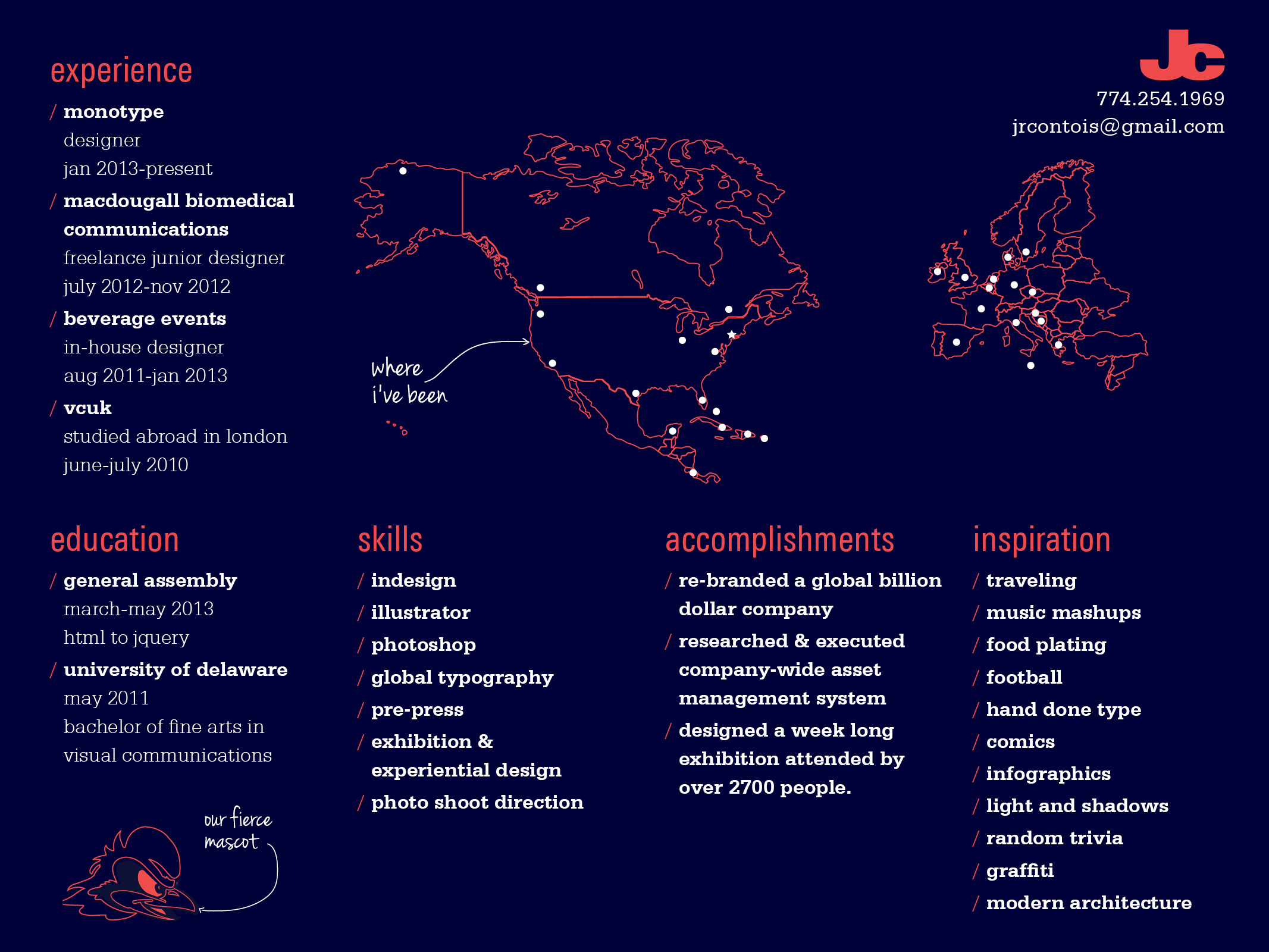
Note: Actually, this is her updated resume, we lost her original, but it had way less experience and accomplishments on it. And it was a beautiful warm grey and chartreuse color combination that was quite daring. More points for her!